Sunday, November 14, 2010

art gallery

I went to the Burchfield Penny Art Gallery for this assignment.  This assignment was a little different that the last one because I had to focus on space, architecture and lighting.  There we two major types of lighting in this gallery.  The front of the gallery used a lot of natural lighting from the ceiling as well as some big windows found throughout the gallery.  For the most part threw the gallery there were individual lights pointing on the pictures.  The walls were white for the more modern art and dark grey in the rooms with the older collections.  I noticed several pillars in the middle of the buildings and beautiful wooden staircases for some of the architecture.  The museum was set up so that it flowed for you to walk through.  There wasn’t much option as to which direction to go, it seemed to me that it was designed for you to walk a certain way.  One thing I did notice as far as space is that the ceilings were extremely high.  Some of the rooms had works of art hanging from the center from the high ceilings.  The art work was for the most part evenly spaced out.  I thought it was odd that some of the art work was hung so high that you really good not get a good look to analyze and interpret it.  Most of the artwork was not individually labeled.  The name of the artist would be on the wall and sometimes there would be one sign for all the artworks.  Most of the modern art work did not have frames.  The room with the older artwork had old elaborate bronze thick frames.  I feel the gallery can be broken into old and new.  The older artworks were similar in that they contained usually a self portrait or a picture related to wars going on.  They differed in that they picked different topics on wartime to focus on.  The modern art in the gallery different because some of it was three dimensional, some of the artwork was photography.  Other consisted of collages and some were drawings and paintings.  Each room had a specific theme.  The proximity of the artwork varied in different parts of the museum.  Some rooms only had one picture on a wall, usually in the center.  Other walls contained pictures evenly spread out, one following the other.  The artworks that hung from the ceiling generally were in the center of the room.  One of the exhibitions I passed was the exhibition cabinetry design.  There was a lot of pottery and plates in the cabinets with war themese painted on them.


In this water color painting I see a house that is extremely old.  To the side of the house there is a barn.  Both the house and the barn are surrounded by trees.  With in the trees there is an owl.  There is a wide open feild with trees further in the background.  This painting by Charles Burchfeild is not a realistic one.   This paitning reminds me of something scary.  Burchfeild uses space to empahsize the house.  He also uses colors that depict old and frightening tones.  The trees do not appear to be in proportion to the house.

This spray painting is of a garbage pile.  There is a pond in the front that shows the refelction.  This very well could exist in real life.  The artist uses rythm and repeats the same thing over.  He also uses light in the reflection of the pond to empahize how large it really is.  He also uses dull colors to show how the site is gloomy.  I think the artist is trying to get you to realize how much garbage there can be found everywhere and I feel that this painting is effective.  I think the medium  of spraypaint that was used also represents clutter and filth becuase of the negative image spray paint carries.


This particular artwork is literally just a hermit crab on top of a rocket ship.  This artwork is inside a cage with out a top, almost like a crib.( didn't capture the whole picture in my image)  The artist choose all white ceramic for this artwork.  This can symbolize the symblicity of the message she is trying to convey.  The symbolism beheind this is that a person or hermit crab is often viewed to be from another world.  I believe this is what the artist is trying to get across.  This sculture is one of three in the exhbit that have similar meanings about people who are seen as hermit crabs.  The sculpture is placed in side an empty cage with nothing around it.  The space also emphasizes the simplicity.


Friday, November 12, 2010

video 11-12

The first video that I choose was the Picasso and Matisse one.  I thought this video did a great job showing many of the differences between the two artists.  I picked this video because I like a lot of Picasso’s work but was unfamiliar with Matisse’s work off the top of my head.  We study Picasso in many chapters in the book.  This video breaks down the two artists and points out a lot about them.  I particularly enjoyed a lot of the quotes in the video, “Life’s a Bitch” “ Drawing is art with less materials” “ Painting a picture is a dramatic action in course which reality is disengaged.”  I learned more about Picasso then what I could get from the reading in the book.  I learned that ¾ of the object that he uses in his paintings never existed.  He often used worthless objects because they interested him.  Picasso’s work after WWII turned very dark.  Picasso was a very impulsive man.  Matisse is believes that man breaks free from nature.  Matisse was a man that was unaware of his talent for the longest time.  Unlike Picasso his art did not turn dark after WWII.  Matisse believed that the sky symbolized both pleasure and anguish.  Painting caused Matisse panic, fear and struggle.  Gretude Stein would bring both Matisse and Picasso together.  They would respect each other and they would exchange their work.  I enjoyed this video.
I also watched the video on Dada and surrealism.  Like the book this video stated that Dada and surrealism would bypass reasoning and reach the unconscious mind.  I picked this video because this section in the book caught my eye for some reason.  This was a reaction to WWI.  Kurt Swhitters would use Picassos collage techniques.  He says that art is a life of his own.  He would use objects like tram tickets in his work.  He was also into music and poetry.  He would soon be exiled out of the country.  This video was not that interesting to me. 
I watched the video on Expressionism.  Edward  Munch would use the relationship of men and women and sexuality in his paintings.  He is famous for his painting on Ashes.  He would use colors that would symbolize emotions such as red black and white.  He claims that he does not paint what he sees but what he saw.  He was also known to create his work several times and alter it each time and create a new meaning.  Franz Marc in this video was known for his painting the Blue Horse and the Tiger.  He would boldly renounce everything. This video mentioned a lot of what we learned in the book.
I watched the video on Cubanism.   This video relates to our textbook in several areas.  A famous Cubanist painter Juan Gris would often in cooperate architecture in his paintings.  He is known for his painting the Violin and the breakfast table.  Another well known cubanist painter would be Marcel Duchamp.  He would focus on movement in his paintings through space and time.  We covered this when discussing elements of art as well.  Dulaney was an artist who would take this a step farther and would focus on light and color in his work.  He used this in the Eiffel Tower.  He would not stop at the surface but analyze the inner law.  He was also known for his circular form art.  The colors themselves were the objects in this painting.  I thought this was interesting.  He said that this particular art was not meant for interpretation but designed just to look at.  I found this topic interesting and a touched base on this topic in my Mexican History class and how art influenced politics. 

Sunday, November 7, 2010

mask

Yurupari Mask
.
Ticuna people, Western Amazon, Brazil
14 inches, reeds, wood, bark cloth
I choose this mask because it really stood out to me.  Compared to other Amazon masks this one to me looks the most authentic.  My guess would be this mask would orginate during the slavery period in Brasil when the African American population was the largest.  I think this mask looks the most African and it caught my eye because of that. 

IYurupari Mask
Ticuna people, Amazon
20 inches, carved wood, bark cloth hood 

I Picked this particular mask becuase I love learning about the tribes in Brasil.  I think that the western Amazon is a very interesting place and I think that these masks show the the tradtional skin and texture of the indiginous poeple.


I enjoyed this project.  I wasn't show much into the actual drawing of the mask but I really did enjoy looking at all the masks.  I concentrated on three masks from the Amazon region.  I tried to portray all three of the masks into one.  I stayed with the colors yellow brown orange and grey because that is all the colors they seemed to only contain.  I kept the mouth narrow becuase in all three mask no one was smiling.  The eyes are narraw as well in all three.  I put the background of the eyes yellow because in the first mask that had yellow eyes it really caught my attention.  I felt this was the focus point of my mask.  I used long lines for the nose because it seemed like they all had long noses.  I think I would enjoy doing this project in an actual art classroom where there would be more materials to create this mask in 3D. 
Yurupari MaskWhite Man mask
Wichi people, Northern Argentina
9 inches, painted wood


I picked this particular mask because I study Argentina in school and I thought it was interesting.  THis mask depicts the white men that arrived in Argentina, the Wichi tribe would make fun of the white men from Spain who looked funny to them.  This reminds me of the reading in the text about the African masks and how they too would represent the white men that came to Africa. 

Friday, November 5, 2010

week 10

The first video I picked was the one on Buddhism.  Different relgions have always fascinated me.  Reading about the influence in art from Buddhism made me want to look into it more.  THis video begins to explain people who practice Buddhism believe you should be in the world and not of it.  They try to free themselves from their ego.  This video showes parts of India where the rivers flourished.  Buddha was seen as a saint and savor in India.  The city of Sanchi would honor buddha with relics every where.  Stuppas were an archetecturial influence that Buddhism had in culture.  They were funeral burial sites.  Much of the Buddhist art contains elephants, pot belly dwarfs and lions.  One thing I found interesting is that there is a very well known monastry in upstate New York.  This video was very educational and showed a lot interesting art work

The Second video that I choose to watch was the one on Hinduism.  Hinduism and Buddhism are very similar and I thought that this video would be just as interesting.  One thing I liked about this video was the music it used in the background.  I enjoy the spiritual music of India.  Hinduism beleives that Heaven is on Earth.  They differ from Buddhist in that they believe in reincarnation and everything that they do will affect who they will be in their next life.  The oldest city in the world is Varanasi in India.  India has very elaborate architecture all over becuase they beleive that can worship anywhere.  One of the cultural aspects of India is the burial of their dead.  Aarti is the name of the ceremony that is used where the dead float across the river into the afterlife.  During this whole ceremony Hinduists are not allowed to touch the dead body.  I think that this video was important in understanding where some of the Indian art and why it is so important in the Indian society.  This video showed the importance of architecture in India.  This can be related to our lessons on Indian Art as well as architecture.

The third video that I watched was the one on African Art.  I picked this one because I think that African tribes are very interesting.  African Art  is dress, hair and tradtional relics.  African art is used in ceremonies, especially dance.  This video was interesting when it got to the part about the masks that are used.  Most of the masks rarely date back 200 yrs plus because of the very degrateable materials that they are made of.  The video also talks about tradtional rock painting in Africa.  we seen this several times int he text when it talks about cave paintings.  The pictures were very interesting becuase they were dead on what the animals really looked like.  They were very accurate and you can easily pick out what each animal is supposed to be.  This video then goes on to talk about the Bronze casting in Egypt.  We have learned several items about Egyptian art in previous chapters.  I think this video captured some very interesting African masks and really caught my attention.

The last video that I picked was the one on Japnese art.  I picked this one hoping it would be on modern Japenese art, anime.  I knew the odds of that was rare because the textbook talks apart early artwork but it was worth a shot.  This video is about the Great Wave that is known everywhere in Japan.  It shows us how nature inspires.  The orginal painting was done in layers by Hakusai.  One thing that I found interesting in this video is that it was so cheap to obtain a copy.  I found it hard to believe that something so valuable in a culture was so cheap.  The great wave painting was important becuase it shows the freezing of time.  This was a new topic in art at this time.  The wave is commonly known by many and often used in everyday Japanese culture.  Poeople have pictures of waves on their clothes,walls and even tattoo a wave on their body.  The wave symbolizes the cause and affect, chaos and order.  I think that this video was interesting because it really shows us how important it is.  I thought the tattoos really made me realize how important it really was.

Saturday, October 30, 2010

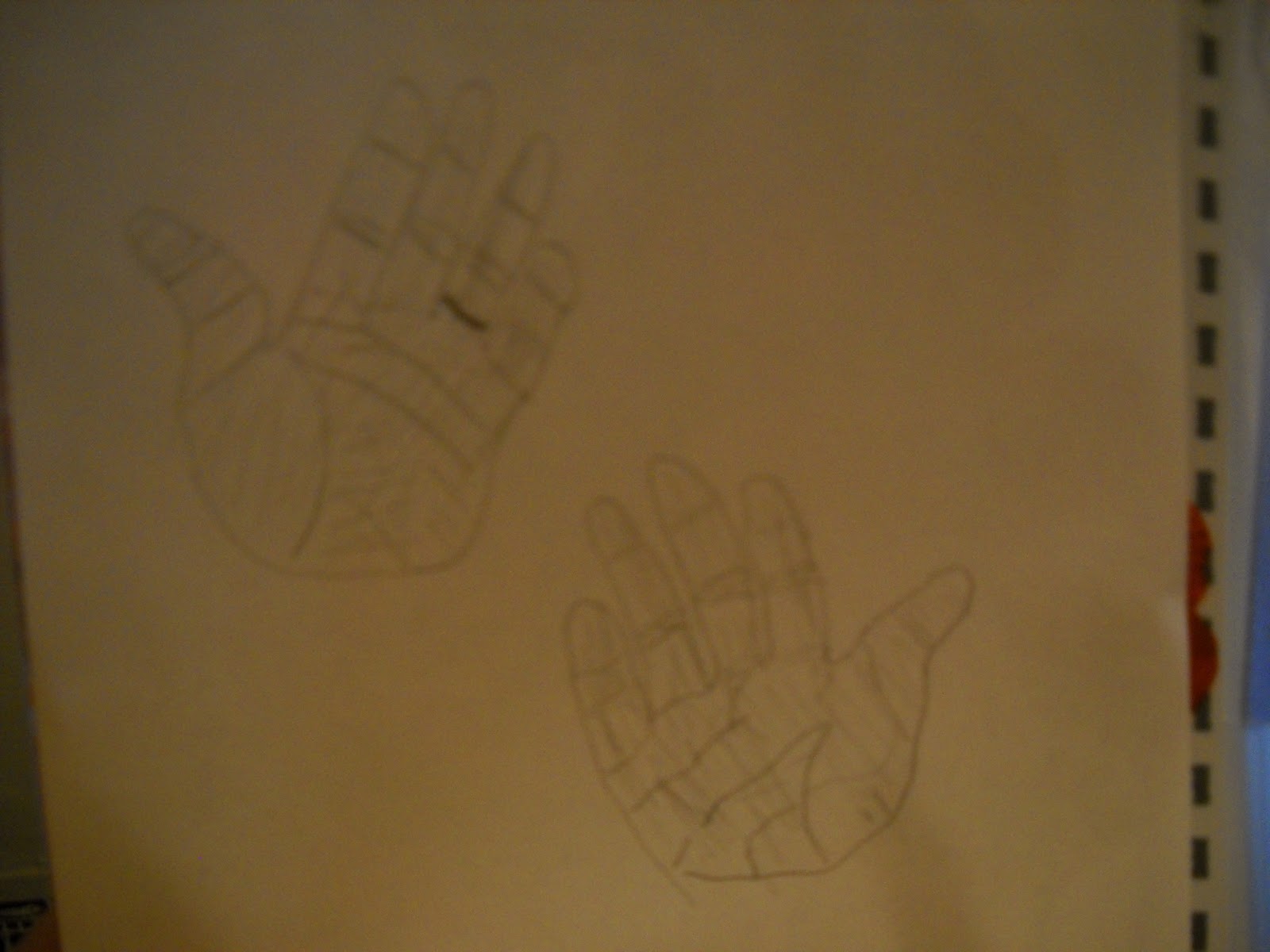
It was a little weird using my hand as a subject for drawing because It kept shakening.  It was however convientant.  I choose a pencil honestly becuase I did not have any charcoal.  I have never used charcoal before for drawing anyways.  I thought drawing with my non dominant hand was fun to try.  My picture however looks like a third grader drew it.  I do not have much experience using my non dominant hand for anything so my hand was very shaking and the picture is out of proportion.  The angel i held my hand and the way I drew it looks like one of those kindnergarden turkeys you make with your hand for thanksgiving.  I do not think this is a very good study for anyone to use.  I can not draw to save my life.  I  do think that the picture of my left hand is better and it does show the details in my hands with the various line and creases but once again i dont think it is drawn in perfect proportion.  I would not use my dominant or non dominant hand to create anykind of drawing that I wanted someone to enjoy.  Maybe if it was a more abtrasct project and was open for intrepetation I would consider it becuase I would be able to get away with a lot more, but for a drawing of an object I can't say that I would. 

Friday, October 29, 2010

Video blog chapter 16 and 17

The first video that I choose to watch was the one on Velazquez.  I choose this video because I remembered hearing him recently mention in my Mexican history class and I was interested to learn more about him.  We did not learn much in my class other than he influenced some of the Mexican artists.  One of details that I knew from my course was mentioned in the video that Velazquez belonged to the great quartet of Spanish painters.  Velázquez was appointed to paint for King Philip the IV.  Velázquez was known to capture the moment through light and time.  Velazquez was a man with only one friend the king in which he painted for.  I was surprised when the video said he had a wife because it’s hard to meet someone when you have no friends, although in that time period it was probably an arranged marriage.  Velazquez would study the Italian artists like Michelangelo and Raphael and would come home and have deeper meaning and awareness in his artwork.  Velazquez was known as an idealist.  He had no concern for shapes and would often express character.  This relates to the book because we learn of painters who are idealists and we also learn in the book that the works of Michelangelo and Raphael would be works that were studied and mirrored by many.
The second video that I picked to watch was the Drawings of Michelangelo.  I picked this movie because he is a very popular artist and I was interested to learn of his drawings that aren’t often brought up.   The video mentions how the drawings that were done of Michelangelo were kept hidden and often destroyed by Michelangelo himself.  The video said that this was mostly because he was a perfectionist and the sketches showed him second guessing himself.  His drawings were mostly sketches of what was to be painted in the Sistine Chapel.  This video was very informative of Michelangelo’s background.  When I think of Michelangelo I do not associate drawings with his name.  This video did a great job pointing out the in depth detail and perfection that Michelangelo used in his drawings.  They used a technique to compare both the actual sculpture with his drawing to point out that his drawing was of a sculpture body and not just a body.  They even pointed out that Michelangelo would often construct his sculptures based on the angel in which a person would view it and not just on detail.  Of the videos I watched I think this one was the best.  He related to the text several times, especially when mentioning all the contour lines Michelangelo would create that would just find their way.
The third video that I watched was the one on Leonardo Da Vinci. The video talks about how Leonardo was a left handed man and would often write mirrored. I just found that fact to be odd.  Leonardo was not picked to paint in the Vatican which did upset him.  He lined up some of his jobs due to the connections his father had.  One thing that I did enjoy about this video even thought I felt it was a little slow and dry was the fact that they showed the other aspects and qualities Leonardo had.  I was unaware that Leonardo was so versatile.  Like Michelangelo he too had a lot of drawing that he did.  Leonardo was a military engineer and could build bridges and ladders.  He also could build closed chariots for fighting and catapults.  I don’t recall hearing this in the book.  Leonardo also was a city planner that would help reconstruct Italy after the plaque.  This was mentioned in the text in the Renaissance period.  He was also a scientist and inventor besides being a painter.  I liked the fact that they showed how important Leonardo was to the city and that he was not just a painter but helped with many projects.
The fourth video I watched was the one on Rembrandt.  I picked this one because I knew little on the history of Rembrandt.  I think that video did a great job in showing just how important he was to the Dutch.  The video goes on to explain how he is an icon of Dutch art.  He is most famous for his painting the Night Watch.  This was considered to be an object of Dutch pilgrimage.  The original painting had been through some tough times, it was slashed, had acid poured down it and even submerges in water.  In this painting there are several aspects that catch your eye.  One of them being that the man in front has his hand out to you like he is trying to reach out to you.  Another aspect is it is set up as a military style yet there is a girl in the back of the picture and it makes you wonder why she is there.  The video shows the importance again to the painting in the fact that they mention the arguments that would take place over the lighting of the painting to the audience to give off the best angel. There was even a committee formed in 1902 to come up with a decision.  This painting was only removed out of the museum twice by the Dutch.  It was removed once willingly for the princess and celebration and another for the war to protect it.  The video showed old pictures of the police escorts that would follow the painting.  I thought mentioning this really hit home just how important this painting truly was to the Dutch that they would hide the painting in a castle.  Rembrandt is mentioned in the text for the same reasons.

Friday, October 22, 2010

chapter 14 and 15 videos

The first video that I watched was more human than human.  One of the more interesting facts that I enjoyed was the finding of the Venus of Wilendorf.  It was an overly distorted image of women.  The thing I thought was most interesting about the sculpture was that it was originally only 10 centimeters.  This meant that it was pocket size and was for the purpose of carrying around places when the nomadic tribes movies. This particular work of art was an example in the text. Another aspect of the video I enjoyed was the tomb of Ramses VII.  The video pointed out that there was over 1000 human figures painted inside.  I thought this to be unique because of the scale that was used to keep every Egyptian human painting consistent.  I felt this related to the reading, in that the use of humans being put in the Egyptian art.  The video also mentioned the importance of hierarchy and stability in the Egyptian society; this was mentioned in the book as well as the video the way art portrayed the importance.
The second video that I watched was the one about Gothic art.  I watched this one thinking it was going to be dark and gloomy; it was not what I had expected.  One of the reoccurring themes of the video was England’s quest for identity through art.  Another topic that I found was interesting was the spread of regionalism.  My favorite sculpture of this video is the one with the knight in full armor on his horse slaying the dragon.  The amount of detail in the sculpture was tremendous.  Another reason why I enjoyed this particular sculpture was the fact that it took an unreal event and image and made it look as if it could exist.  The amount of elaborate detail that was put in the particular work of art made it seem as if slaying dragons was a normal part of a knights life.  This video references many cathedrals and their style of gothic architecture that was a man topic of chapter 15.  This video was very informative.

The next video that I watched was the one the Middle Ages.  I was shocked to learn that the medieval way of living still existed today in Camaru Africa and they even still use feudalism.    I thought that the Chitan (sorry if I butchered the name) most of been strongly built of it with hold its Islamic enemies.  I thought it was interesting that some of the nature around this fortress also helped in aiding in the protection.  The video showed people collecting venom from the snakes in present day for research.  I can imagine that back then some of the invaders were attacked by the poisonous snakes while waiting to attack.  This video also talks about the fall of the Roman Empire and how the architecture could not with stand everything that was going on around them.  They especially had a hard time trying to hold back from Attila the Hun and all of the followers that attacked on horseback.  The video also pointed out that the architecture that was built during the the Roman Empire was not defensive but decorative as well.  The Romans wanted to make a good impression on visitors for the first time coming to see them and the outside walls would be the first thing they saw.  The ending of this video goes on to talk about how the nature was started to be taken into consideration when developing new architecture.  They would incorporate natural barriers as defense mechanisms in where they would locate their fortress and example of this was mountains.  While this does relate to this chapter on Roman architecture I feel that it can also relate on a previous video we watched about Frank Lloyd Wright.  While it is a farfetched idea in a way, they both tried to incorporate their surrounding in their architecture.  I picked this video because I find the middle ages to be interesting.  I think this video was could also be used for a history class on middle ages.  It gave a lot of facts on what was happening in the middle ages.
 
The last video that I had watched was the one I found most interesting, Cataclysm- Black Death Visits Tuscany.  I picked this video because I found this topic very interesting in the past and I was interested on learning more of the plague.  This video dealt with our readings in the fact that the architecture had to be expanded to allow for new people to live within the city walls.  A problem that both Sienna and Florence had was that there were more people than food to supply them or space for them to live.  People were in a poor standing and it allowed the Bubonic plague to spread to easily.  I could probably write pages on this video because I felt it really kept me engaged and was once again very informative from a historical point of view.  This video focused a lot on the influence on the Catholic church in the Italian culture and the need for proper burial.  This was a problem in the fact that funerals could not be held up to the Catholic Church standards nor the anointing of the sick because the clergymen were some of the first to die off from the plaque.   This video also talks about a mosaic that was painted with elaborate detail about Jesus Christ.   This depiction of Christ is directly related to the readings in the rise of Christanity.